

■ Domestic Startups Making Sequential Inroads
AIDOT Collaborates with 5 Local Hospitals
MedInTech Discusses Endoscopy Business
"Utilizing Data as Evidence for Entry into Africa and Beyond"
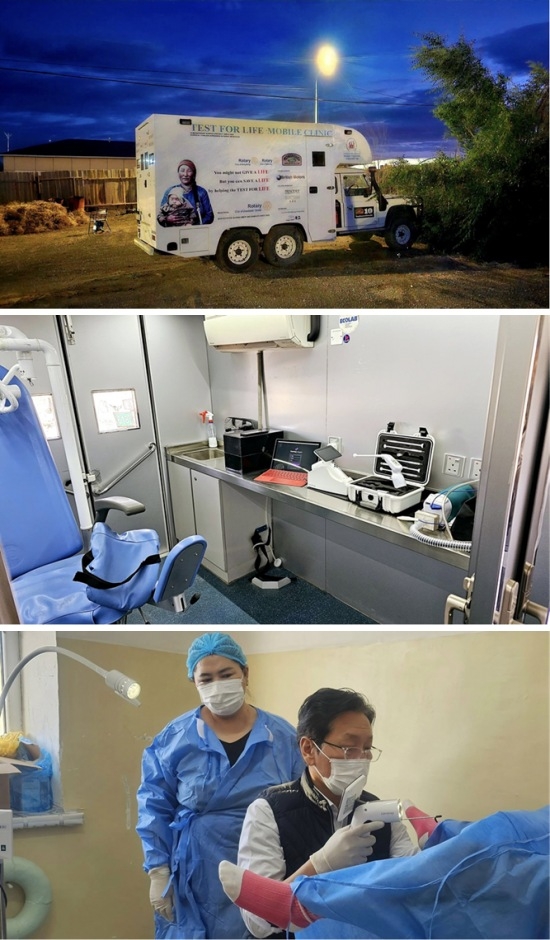
Cervical cancer diagnostic AI company AIDOT is conducting screenings across various locations in Mongolia, including the Gobi Desert, with the on-device version of its 'Cerviray AI' screening system mounted on vehicles. Photo provided by AIDOT.
Domestic medical artificial intelligence (AI) startups are accelerating their expansion into the Mongolian market. The region is deemed ideal for accumulating real-world verification cases due to poor medical and telecommunications infrastructure, along with high incidence rates of cancer and cerebrocardiovascular diseases. Furthermore, strengthened medical cooperation between the South Korean and Mongolian governments this year is believed to be boosting entry into the public healthcare market.
According to industry sources on the 22nd, Talos, an AI cerebrovascular disease prediction company, is discussing the introduction of its solution 'ANRISK' with the Third State Central Hospital of Mongolia. ANRISK is a solution that analyzes general health checkup data using AI to predict the risk of cerebral aneurysm occurrence without additional cerebrovascular imaging tests. Following an exclusive supply contract signed with Mongolia's MG Hospital in May last year, the company aims to secure additional patient data by expanding its local clientele. Talos stated, "We are also scheduled to hold a first meeting with another international hospital in Ulaanbaatar in November."
AIDOT, a cervical cancer diagnostic AI company, is also expanding its local real-world validation. Having recently been selected for the "2026 Gangwon AI Healthcare Global Special Innovation Zone Enterprise Cultivation Support Project," AIDOT is currently validating the on-device version of its AI cervical cancer screening system, 'Cerviray AI,' in partnership with over five national, public, and private hospitals in Mongolia. The on-device version can analyze cervical images using portable devices to classify suspicious lesions even in grasslands and deserts where internet connection is difficult. Jeong Jae-hoon, CEO of AIDOT, said, "I plan to visit Mongolia in person next month to discuss additional MOUs with other institutions and explore business opportunities." MedInTech, an AI endoscopy company, is also securing local usage cases for its electric endoscope 'INTUION S,' launched in June this year, while discussing further business with local distributors and agencies.

Behind the growing appeal of the Mongolian market lies its vast territory coupled with insufficient medical infrastructure and a high burden of cancer and cerebrocardiovascular diseases. According to the International Agency for Research on Cancer (IARC) and the World Heart Federation (WHF), Mongolia's mortality rates per 100,000 people for cardiovascular diseases and cancer as of 2024 stand at 312 and 171, respectively, which are about 1.5 to 2 times higher than the global average. Consequently, for medical AI startups seeking overseas expansion opportunities amid intensifying domestic market competition, Mongolia has emerged as a key overseas validation hub connecting to Southeast Asia. CEO Jeong explained, "Mongolia is a market where we can secure real-world data validated in extreme environments, which can serve as direct evidence when expanding into other medically vulnerable countries in Latin America, Africa, and beyond."
In particular, as the South Korean and Mongolian governments strengthened cooperation in the AI, bio, and medical sectors this year, the industry expects the barrier to entering Mongolia's public healthcare market to be lowered further. In July, the Ministry of Health and Welfare revised its Memorandum of Understanding (MOU) on healthcare cooperation for the first time in 15 years, explicitly specifying cancer and cerebrocardiovascular disease management as well as AI-based digital healthcare as key areas of collaboration. Both countries are also pursuing a feasibility study for the construction of Mongolia's Second National Cancer Center using the Economic Development Cooperation Fund (EDCF).
In relation to this, CEO Jeong stated, "An institutional foundation formed through intergovernmental cooperation has been established for our expansion into Mongolia, which had previously been pursued at the private enterprise level," adding, "It has completely shifted the starting point when discussing adoptions by national and public hospitals as well as integration with national screening projects." Kim Na-yeon, Chief Operating Officer (COO) of Talos, also remarked, "The intergovernmental cooperation framework will help secure trust from local hospitals and health authorities," adding, "We plan to actively participate in follow-up projects such as joint research and real-world validation."
Seoul Economic Daily / 2026-10-22 / Reporter Jang Hyung-im


